Veneza
Destination
Explore Venice! This Italian jewel is built on 117 islands separated by magical canals. Discover the historical architecture and charm listed as an Italian World Heritage Site. Plan your trip.
Veneza · Brasil
Photos
Discover the landscapes and culture of Venice
Editorial guide with history, culture, and practical tips to plan your trip.
Venice is a breathtaking destination, a unique and magical city nestled in northeastern Italy. Its existence challenges terrestrial logic: it did not develop on solid continent, but rather upon an intricate grouping of small islands. This unique setting has seen the very definition of Venice rewritten by nature and man.
The urban geography is marked by a complex network of navigable canals—the city's famous artistic rivers—that intersect, encircle, and connect different inhabited areas. These islands are not merely patches of land; they form a cohesive ecosystem where water and human layout are in constant dialogue. It is a landscape built upon the lagoon itself, giving the city a unique maritime character, even to those who have never been near the open sea.
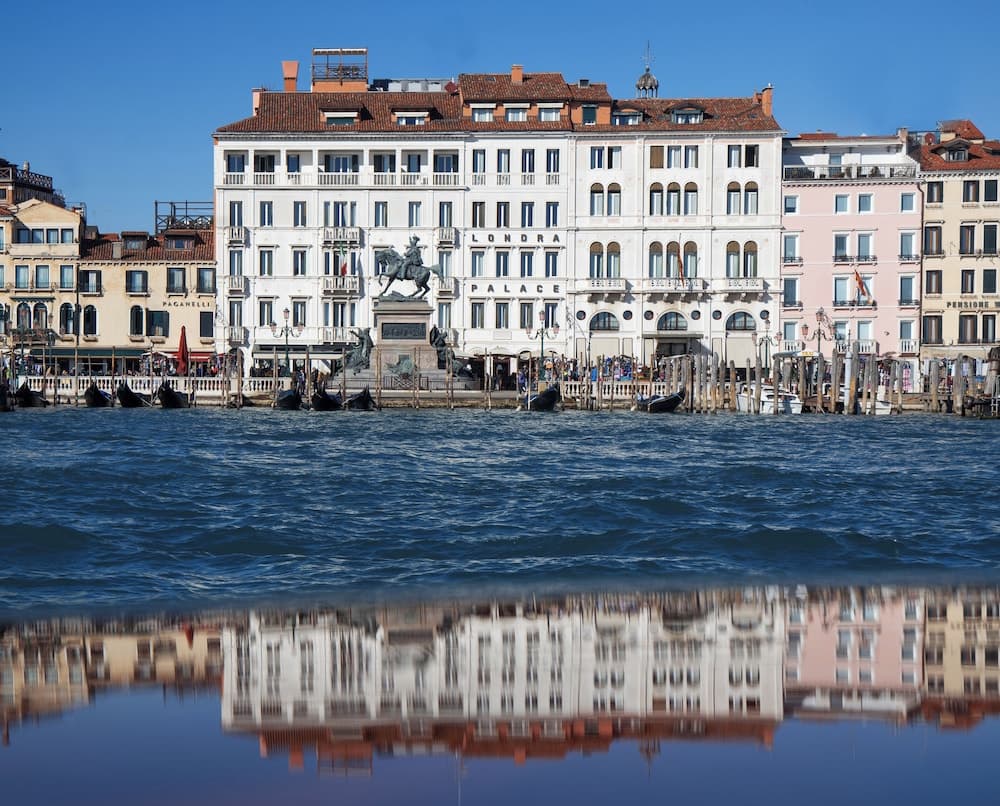
More than just a transit point, Venice is globally recognized for its unmatched architectural beauty and monumental artistic collection. The fact that a significant part of the city, along with the majestic Venetian Lagoon surrounding it, has been designated a World Heritage Site attests not only to its aesthetic value but also to the historical and cultural importance it represents to the world.
The living population, estimated at over 264,000 inhabitants, resides in this peculiar setting, living in harmony with the waters. Walking through Venice is an immersive experience where every bridge and archway reveals a chapter of history unfolding since its birth upon these small land formations.
Although the source does not provide exact chronological dates, the mere fact that the city exists is a powerful testament to its long and rich historical trajectory. Venice built its identity and resilience in an environment of singular geographical challenges. Its history is intrinsically linked to water resource management and the mastery of maritime trade, which has always been its pillar.
The evolution of the city tells the story of remarkable human engineering, adapting perpetually to a swampy environment—the Venetian Lagoon itself. Its inhabitants did not just build buildings; they built a way of life that respected and depended on the canals. This symbiotic relationship with water shaped architecture, social routines, and even transportation.
The permanence of this civilization upon 117 islands separated by waterways is a millennia-old feat. The preservation of its architectural and artistic legacy is not a coincidence; it is the result of centuries of care, adaptation, and dedication to keeping the memory of its grandeur alive. Its World Heritage status precisely recognizes this cultural and structural resilience that persists to this day.
Venetian culture is a rich tapestry where art and way of life intertwine on every corner, in every winding canal. It is a culture that breathes romance and history, directly influenced by its unique aquatic geography.
Venice's artistic collection cannot be overstated. Architectural beauty is the first indicator of this cultural wealth. The buildings, with their colorful facades and varied styles, narrate the history of the different eras that have passed through the city. Artists and artisans were the forgers of this aesthetic, creating works of art that adorn the walls and public spaces.
The way of life in the city itself is a cultural ritual: the sound of boats sliding through the canals, the slow movement of the bridges (moses), the interaction between inhabitants and visitors. Venetian culture values detail, beauty of design, and the passage of time. Every corner possesses a distinct atmosphere, whether grand or intimate.
This fusion of art, history, and daily life makes Venice an open-air museum, where works are not confined to galleries but are part of the urban structure itself. Cultural life unfolds amidst the water, granting the city a magical atmosphere that transcends time.
The geographical description of Venice is, in itself, one of its greatest mysteries and beauties. It is crucial to understand that the city does not possess a single land perimeter; it is composed of over 117 small islands.*
These islets are the stage upon which all civilization developed. The defining element of the landscape is undoubtedly the vast network of canals that separate and connect them. These canals are not mere decorations; they are vital thoroughfares for transport, for the flow of life, and for territorial definition itself.
Venice is strategically located in an area known as swampy—the Venetian Lagoon. This lagoon extends along the coast, functioning as a gigantic natural reservoir connecting the Po and Piave rivers. This river connection not only defines the broader geographical context but also gives the lagoon its unique coastal ecosystem characteristics.
Venetian geography is a study in contrasts: the stability of solid architectural structures confronts the fluidity and unpredictability of the surrounding water. It is this balance between the solid (the islands) and the liquid (the canals and lagoon) that grants the city its unmistakable charm, making it a geomorphological work of art.
Although specific factual data on seasonal climate variations are not detailed in our collection, it is possible to place Venice within the Mediterranean climatic context. Its location in northeastern Italy guarantees an atmosphere that generally favors a pleasant and temperate climate.
This type of climate is typically characterized by warm, sunny summers, ideal for exploring canals and enjoying the charm of the streets. Winters tend to be milder than in other regions of northern Italy, although they are periods where the influence of water is highly perceptible.
The climate here has a direct impact on life and tourist activities. The breeze coming from the canals and the salty touch brought by the Venetian Lagoon modulate the environment, creating a constant feeling of closeness to the sea, even on dry land. It is this soft and enveloping climate setting that allows the city to maintain its preserved beauty for centuries.
Visiting Venice is more than just a simple trip; it is participating in a journey through time. Tourism in the city focuses on the sensory experience of water, bridges, and art.
The central attraction, of course, is the labyrinth of canals. Navigating them—whether by boat or gondola—allows visitors to absorb a unique perspective of the city, seeing its façades in a way that would not be possible walking through the most crowded streets. The canals and bridges, which connect the 117 islands, are the main stage for tourist activities.
The World Heritage status guarantees that visitors have access to an unparalleled collection of architectural works and secular and sacred art. Tourism here demands slow contemplation, a rhythm dictated by the tides and the beauty of discoveries in every historic square.
For the traveler, Venice offers the opportunity to immerse not only in its visual grandeur but also in its artistic sense. It is a destination that delights the senses: the sound of water, the salty smell, the colors of the facades, and the weight of history in every stone.
The most fascinating aspect of Venice is its own geological subsistence. It was not built on stable plain ground; it flourished on the delicate marshland that constitutes the Venetian Lagoon, between the Po and Piave river mouths.
This unique location implies a constant relationship with the aquatic environment. Being situated in such a complex lagoon system means the city is continuously shaped by tides, canals, and the very nature of the lagoon itself. The 117 small islands not only define the geography but also determine preservation challenges.
A striking detail is the contrast between population density (with over 264,000 inhabitants living in such a restricted space) and the built-up area. Living here requires mastery in coexisting with water, using canals as extensions of daily life.
The combination of these elements—the island cluster on fresh and salt water, universal fame for art and architecture that have resisted time, and global recognition as a World Heritage Site—transforms Venice into an incomparable marvel, a true living museum navigating through the centuries.
Everything you need to know to plan your trip
Reference figures to help plan your trip
Hotels in the area
239
Attractions
9
239 properties in the area
Hotels and experiences in the area
Everything you need to know to plan your trip
Venice is a city in northeastern Italy.
It is situated on a group of 117 small islands separated by canals and connected by bridges.
Venice is famous for the beauty of its architecture and works of art.
A part of the city is listed as a World Heritage Site, along with its lagoon.
The Venetian Lagoon extends along the coast between the mouths of the Po and Piave rivers.
Its population is approximately 264,579 inhabitants.
Extend your trip to incredible destinations nearby
We personalize every moment of your journey — from iconic landmarks to hidden cultural gems.
Available 24/7 · Personalized consultations · Local expertise
Updated on June 7, 2026
Sources