Praia do Forte
Destination
Explore Prague, a jewel of Europe! Discover Prague Castle and its historic streets. Experience the magic Czech culture and architecture in detail.
Praga · Brasil
Photos
Discover the landscapes and culture of Prague

Editorial guide with history, culture, and practical tips to plan your trip.
Prague is much more than just a capital city; it is a fairytale destination and a living testament to European history. Located in the Czech Republic, Prague not only holds the title of the largest national urban center but has also established itself as one of the most beautiful and ancient metropolitan centers on the continent.
World-renowned by its picturesque nickname, the "City of a Hundred Spires," the city's atmosphere is permeated by a sense of historical grandeur. Since its origins, Prague has maintained organic growth resulting in an extensive and unparalleled architectural heritage. Its winding streets, historic bridges, and monumental structures tell centuries of stories, transforming every corner into a work of art.
The city is not defined solely by its medieval aesthetic; it is also a vital economic engine. Prague functions as the Czech Republic's main industrial and economic pole, serving fundamentally important roles as a robust transport and communication hub connecting the region to Central Europe. This unique combination of rich cultural life, timeless beauty, and modern functionality makes Prague a fascinating and multifaceted destination.
While detailed chronology requires external sources, the factual narrative positions Prague as an urban center whose history is intrinsically linked to its imposing architecture. The city has accumulated centuries of cultural and artistic development, making it a living archive of European stylistic evolution.
The most evident historical legacy is its extensive built heritage. Over time, Prague has not only preserved ancient buildings but has also integrated them into a cohesive urban structure that captivates every visitor. The very foundation and expansion of the city have resulted in an architectural complex that is a subject of international admiration.
The historical development is complemented by its strategic importance. Situated in Central Bohemia, a geographic area that historically granted Prague a central role in the movements and communications of the continent. This privileged location contributed to the city's prosperity as an economic and communication hub from its early days, maintaining the cultural and architectural distinction it possesses today.
Prague culture is vibrant, rich, and palpable in every stone and bridge. It is not merely something to visit, but something felt on the streets, in the music, and in the local way of life. The city is synonymous with an intense cultural life that attracts artists and lovers of history from around the world.
The architectural heritage, which defines the "City of a Hundred Spires," is the greatest mirror of this rich culture. From majestic palaces to small adorned squares, every element tells a chapter of European cultural history. The coexistence of these styles over time creates a unique cultural tapestry.
Life in Prague is closely linked to the Vltava River, whose meandering course has been the stage for countless cultural and social events. The bridges crossing the river are artistic and tourist meeting points, reflecting the deep connection between inhabitants and their natural and built environment. Czech culture celebrates this harmonious fusion of nature and human monumentality.
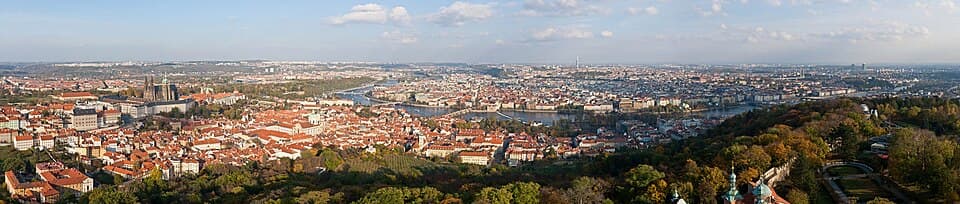
Geographically, Prague occupies a privileged position in the heart of Central Bohemia. Its location is determined by the meandering course of the Vltava River, which cuts through the city on a scenic and dramatic path. The river not only delimits the urban center but has also shaped its identity.
The city is situated upon hills, features that give it distinct landscape beauty and contributed to the defense and development of its large residential and fortified complexes. These elevated areas are notable on both banks of the Vltava. Specifically, on the left bank, or eastern side, stands the imposing Prague Castle (Hradcany), a monumental domain dominating the landscape and panoramic view of the capital.
The natural course of the Vltava is particularly interesting because it occurs shortly before meeting the Elbe River. This confluence, combined with the hilly topography on both banks, creates an exceptionally beautiful and strategic geographic setting, shaping both natural flows and human developments.
While specific details about the climatic regime are not available in the provided information, it is possible to infer the influence of its position in Central Europe. The city is situated in a geographic context that suggests marked seasonal variation, characteristic of major European urban centers.
The combination of being located on hills and the constant flow of the Vltava River creates a distinctive microclimate that tempers the urban experience. Climate variations are part of the beauty of visiting Prague at different times of the year, impacting the colors of the landscapes and the movement of visitors.
Therefore, climate is another element that interacts with its unique geography: the Vltava River, as it winds between the hills, softens and emphasizes the historical environment, ensuring a visually rich atmosphere regardless of the season. This interaction between topography and hydrography is the major observable climatic factor in the travel experience.
Prague attracts tourists with an irresistible mix of architectural wonders, cultural depth, and modern infrastructure supporting its role as an economic hub. Tourism here unfolds into experiences ranging from contemplative historical walks to discovering the commercial pulse of the Czech Republic.
The undeniable focal point is Prague Castle, located on the left (eastern) bank of the Vltava. Its imposing presence not only attracts crowds but also defines the landscape and feeling of majesty hanging over the entire capital. The beautiful, old bridges crossing the winding river are mandatory walks, offering incomparable panoramic views.
Exploring the streets is a tourist activity in itself: getting lost in the alleys, observing the historic facades, and appreciating the "City of a Hundred Spires" is the classic itinerary. Furthermore, its function as a transport hub ensures that visitors can easily access different facets of the city, combining cultural leisure with observations of modern industrial and commercial vitality.
Prague's appeal lies in a series of unique features that distinguish it from any other capital. It is a living mosaic where monumental past dialogues perfectly with modern life, sustained by its status as an important economic center.
Firstly, the nickname "City of a Hundred Spires" summarizes the vastness and richness of its architectural heritage. The colorful spires of its churches and buildings form a unique skyline in Europe.
Secondly, the symbiotic relationship between the Vltava River and the city is fascinating. Its meandering course not only serves as a visual frame for beautiful and ancient bridges but was also historically crucial, facilitating the development of the community that inhabits it today. Finally, the dominant presence of Prague Castle in Hradcany on the eastern bank is a geographic and historical curiosity; it is not just a monument, but a visible guardian of the capital over the Vltava.
Everything you need to know to plan your trip
Reference figures to help plan your trip
Hotels in the area
291
Attractions
9
291 properties in the area
Hotels and experiences in the area
Everything you need to know to plan your trip
Known as the 'City of a Hundred Spires,' Prague is famous for its extensive architectural heritage, rich cultural life, and being one of Europe's most beautiful and ancient urban centers.
Prague Castle is the imposing point dominating the capital, located on the left (eastern) bank of the Vltava River.
Prague is the main economic and industrial center of the Czech Republic, serving also as an important hub for transport and communications.
It is situated in Central Bohemia, upon hills and on both banks of the Vltava River, shortly before its confluence with the Elbe River.
The Vltava River has a winding course through the city, creating a beautiful contrast with the presence of ancient and majestic bridges on its banks.
Extend your trip to incredible destinations nearby
We personalize every moment of your journey — from iconic landmarks to hidden cultural gems.
Available 24/7 · Personalized consultations · Local expertise
Updated on June 7, 2026
Sources